


Cells are wrapped in, and partitioned by, lipid membranes only a few nanometers thick, which must nonetheless bend, stretch, pinch off, and reorganize on demand. I use statistical mechanics, continuum elasticity, and coarse-grained simulation to understand how membranes accomplish these feats, and how the proteins that associate with them use the membrane surface as a stage for collective behavior. My work falls broadly into the two overlapping themes below. Full citations (with preprints and SI) are on the Publications page.
Phase Transitions in Membranes & Associated Proteins
Phase transitions allow a system to respond dramatically to small changes in its conditions. Membranes host such transitions on two levels: within the lipid leaflets themselves, and among the proteins that bind and assemble on the membrane surface. In both cases, the coupled, two-dimensional nature of the membrane produces behavior that differs qualitatively from the familiar bulk case.
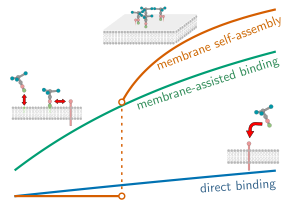 Self-Assembly as a Cellular Switch
Proteins that bind to a membrane gain a dramatic boost in effective concentration, since they are confined to a two-dimensional surface rather than diluted throughout the three-dimensional cytoplasm.
Multivalent self-assembly, meanwhile, can switch sharply from mostly free monomers to mostly assembled structures over a narrow range of concentration or binding strength.
Inspired by the initiation of clathrin-mediated endocytosis, we used theory and non-equilibrium reaction-diffusion simulations to show that combining the two allows reversible self-assembly on a membrane to act as a sensitive, tunable, and robust switch for detecting transmembrane receptors at physiological concentrations, without the irreversible, energy-consuming reactions of conventional signaling cascades
(Foley & Johnson, Phys. Rev. Research 2026).
Analytical expressions for the critical receptor densities that switch on nucleation and growth of assemblies give testable predictions for how each molecular component controls the decision threshold.
 Lipid Phase Behavior under Differential Stress
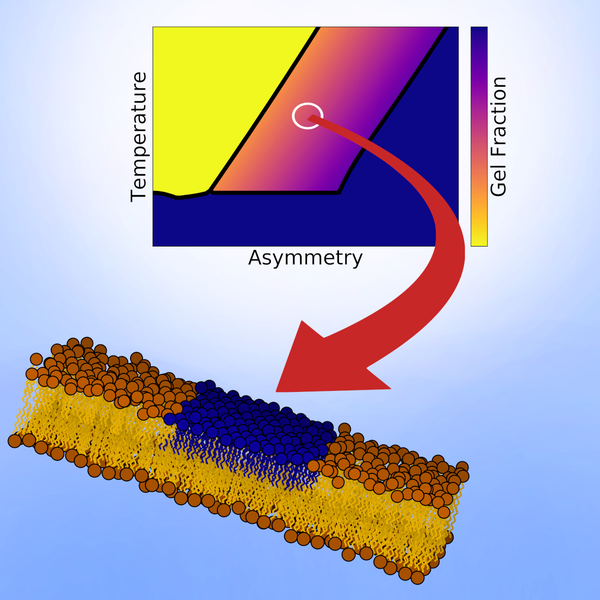
Simulations of strongly differentially stressed membranes previously revealed a surprising
"stiffening transition" in which the membrane's resistance to bending abruptly increases beyond some threshold lipid number asymmetry.
Using my flip-flop-suppressed lipid model (Foley & Deserno, JCTC 2020), I showed that differential stress qualitatively changes the fluid-gel transition of a single-component bilayer: finite gel domains emerge within the compressed leaflet, producing phase coexistence even at fixed temperature and zero net tension
(Foley, Hossein, & Deserno, Biophys. J. 2022).
A theory built from two coupled single-leaflet free energies, in the spirit of a pair of coupled van der Waals fluids, reproduces the coexistence seen in simulation and predicts that the temperature at which it sets in varies linearly with asymmetry.
This suggests a route to inferring a membrane's otherwise hidden stress state by observing its phase behavior
(Foley et al., Emerg. Top. Life Sci. 2023).
Membrane Mechanics & Remodeling
A lipid bilayer is a remarkable material: a two-dimensional fluid that nevertheless resists bending, and whose two leaflets can carry very different mechanical stresses. Understanding these elastic properties, and how proteins exploit them to reshape the membrane, is central to processes ranging from vesicle trafficking to viral budding.
 Membrane Remodeling by Protein Lattices
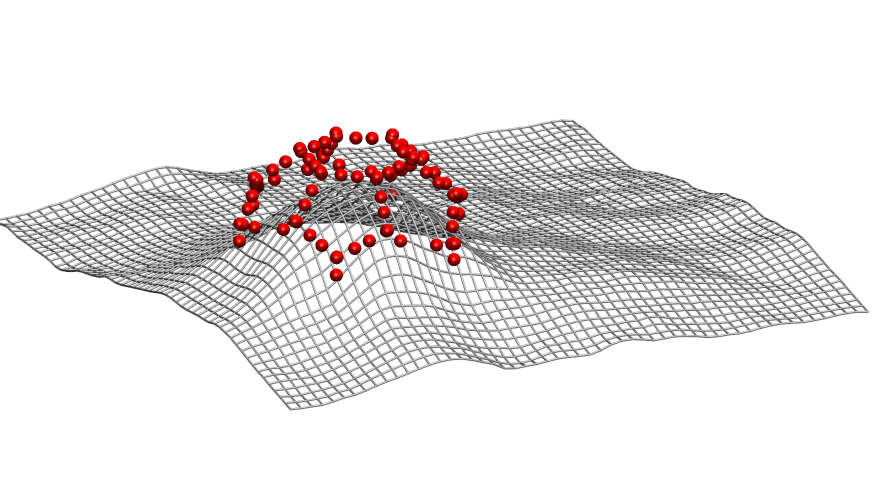
At the cellular scale, large deformations such as vesicle formation are typically driven by protein assemblies.
Clathrin, for instance, forms a polyhedral lattice that coats the membrane during endocytosis.
To study how such lattices bend membranes, I developed a hybrid simulation framework that couples flexible, particle-based protein lattices to a continuum Helfrich membrane propagated in Fourier space
(Foley & Johnson, arXiv 2026).
Applying it to clathrin, we found that the effective bending rigidity relevant for spherical budding is not a fixed property of the lattice: it depends on the lattice's size and connectivity, and increases as the lattice grows.
This is an important caveat for continuum models that assume a single, constant coat stiffness throughout assembly.
The framework can also import structures assembled with the reaction-diffusion simulator NERDSS, which we demonstrated on the immature HIV-1 Gag lattice.
In collaboration with experimentalists in the Zeno lab, I have also been part of work showing that clathrin by itself, without the adaptor proteins that normally recruit it, can drive membrane fission, and that its effect depends not just on how much clathrin is recruited but on how the lattice assembles
(Bouzos et al., bioRxiv 2026).
 Leaflet Asymmetry & Differential Stress
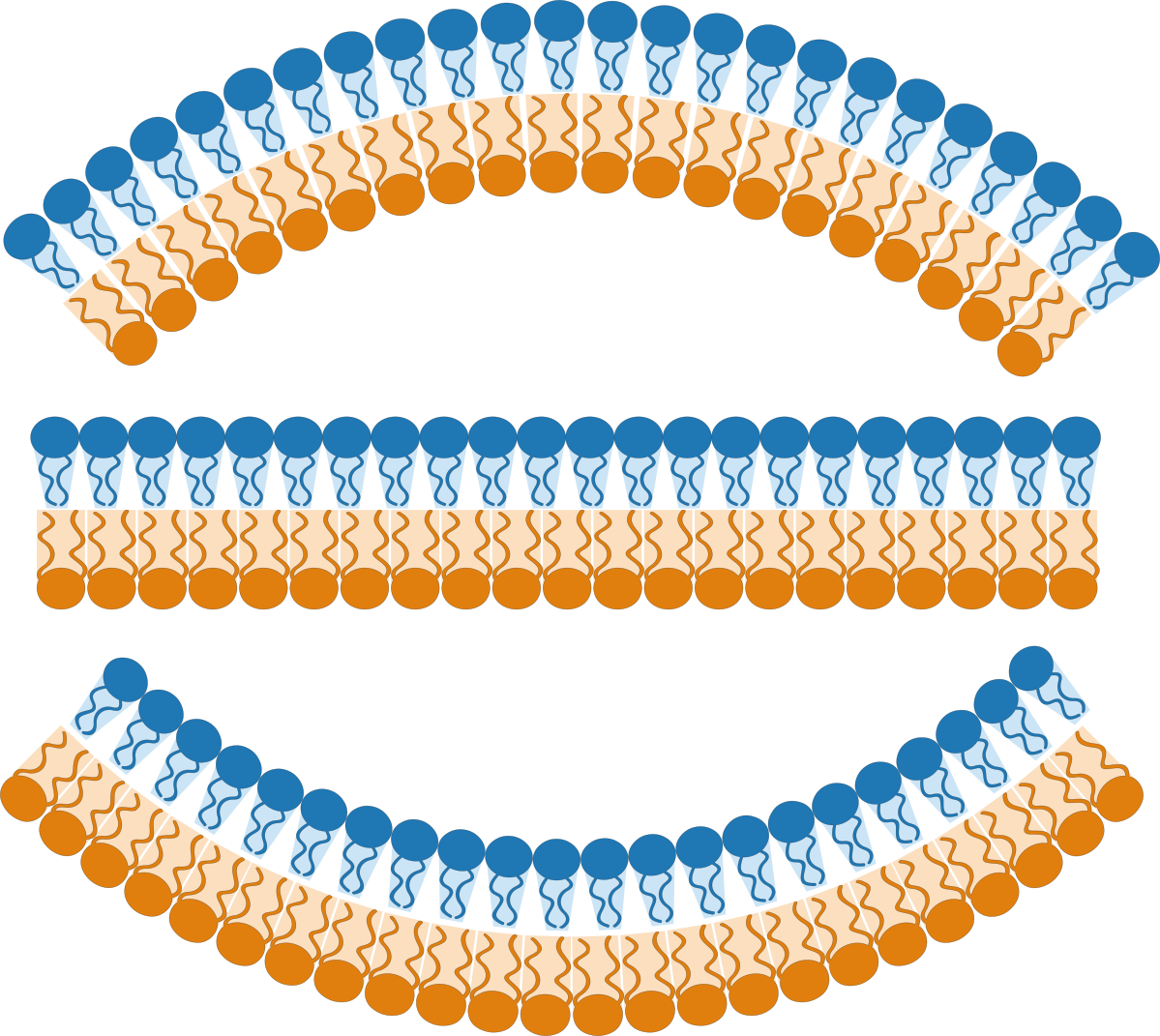
Biological membranes are rarely symmetric. Their two leaflets typically differ in lipid composition, and they can also differ in their state of lateral stress.
This differential stress can be large and yet macroscopically invisible, since the torque it exerts may be balanced by the leaflets' differing spontaneous curvatures, leaving the membrane flat.
Studying it in simulation requires that lipids stay in the leaflet where they started, but in the widely used Cooke model lipids flip-flop between leaflets readily, relaxing away any imposed asymmetry.
I developed a modification of the model that suppresses flip-flop, making it possible to simulate bilayers that sustain large differential stress
(Foley & Deserno, JCTC 2020).
Together with colleagues in the Deserno group, I also summarized the broader framework connecting curvature, lateral stress, leaflet phase behavior, and cholesterol distribution in asymmetric membranes
(Foley et al., Emerg. Top. Life Sci. 2023).
 Simulation & Analysis Methods for Asymmetric Membranes
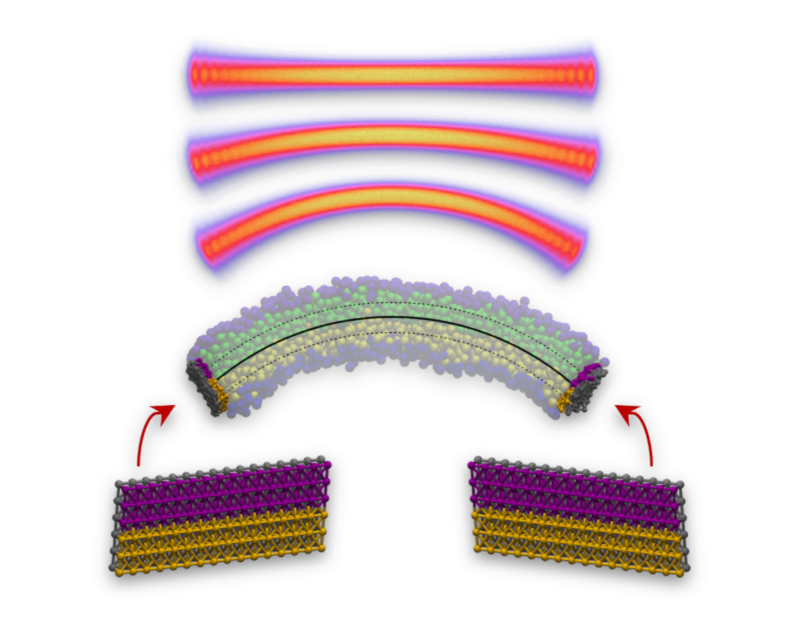
Simulating asymmetric membranes raises a subtle technical problem: a flat membrane patch spanning a periodic simulation box can relax its area, but not its curvature.
To get around this, we introduced membrane "sticky tape": nanoscale tapes adhered to the free edges of a finite membrane strip, which prevent lipids from flip-flopping around the otherwise open edges.
This lets an asymmetric bilayer relax its area and its curvature simultaneously
(Foley & Deserno, J. Chem. Phys. 2024).
Many of a membrane's material parameters, such as its tension and the torque underlying spontaneous curvature, are encoded in moments of its transmembrane lateral stress profile, and I have worked on how to rigorously quantify the statistical uncertainty in these quantities when measuring them in simulation
(Foley & Deserno, Methods Enzymol. 2024).
A stress profile calculator is available on the Code page.